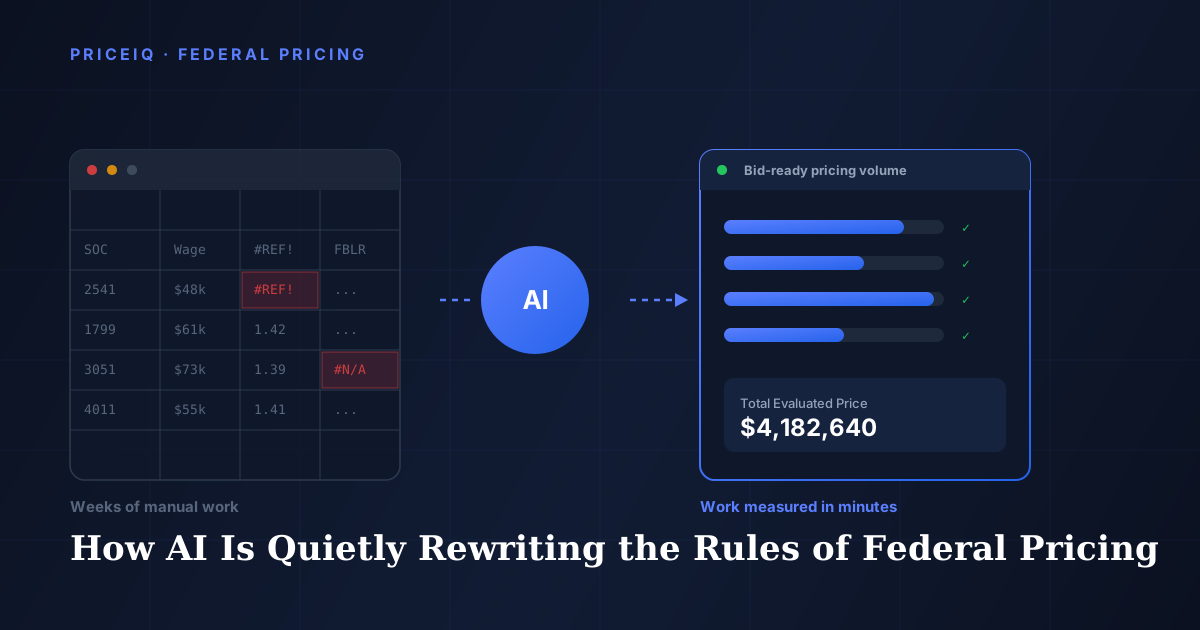
There is a particular kind of exhaustion that only government contractors know. It usually arrives late on a weeknight, three tabs deep in a pricing spreadsheet, when a formula that worked yesterday suddenly returns a number that can't possibly be right. The proposal is due in days. The pricing volume is the last thing standing between your team and submission. And the work in front of you isn't strategy or competitive positioning — it's hunting for a broken reference in a workbook that only one person fully understands.
This is the hidden tax of federal pricing. Not the difficulty of the work itself, but the sheer volume of manual, error-prone, time-devouring effort required to get a single compliant pricing volume out the door. For years, that tax was simply the cost of doing business. It isn't anymore.
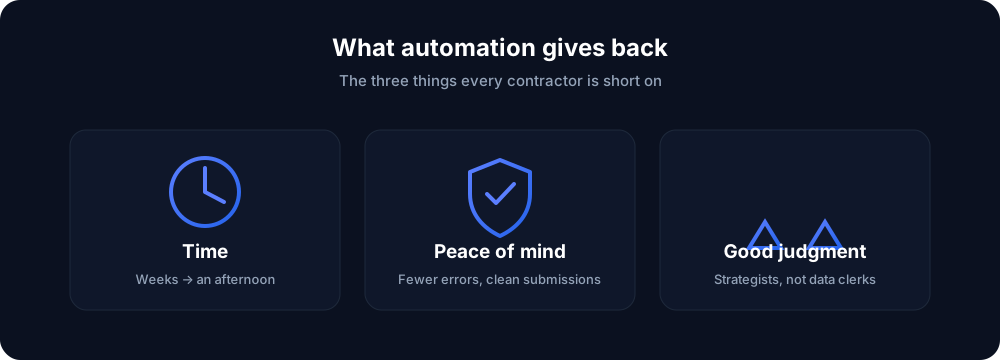
Artificial intelligence has moved from buzzword to load-bearing infrastructure in the government contracting world, and nowhere is its impact more concrete than in pricing. This isn't about chatbots writing fluffy proposal narratives. It's about the unglamorous, high-stakes mechanics of pricing a federal bid — and how automating them gives back the three things every contractor is short on: time, peace of mind, and good judgment.
The real cost of manual pricing
Before talking about the solution, it's worth being honest about the scale of the problem.
A single pricing volume can consume weeks of skilled labor. Someone has to read the solicitation and extract every labor category. Each of those categories has to be matched to the correct Standard Occupational Classification (SOC) code. Those SOC codes drive the wage data — typically pulled by hand from Bureau of Labor Statistics tables containing millions of records. Then come the fully burdened labor rate calculations, applied across multiple years of escalation, formatted into a compliant Excel volume that an evaluator can follow.
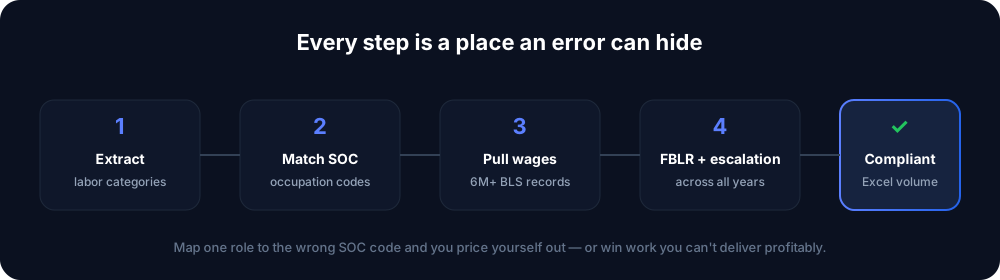
Every one of those steps is a place where an error can hide. And in federal pricing, errors aren't cosmetic. Map a senior engineer to the wrong SOC code and you've either priced yourself out of contention or won work you can't deliver profitably. Fat-finger an escalation rate and the mistake compounds across every year of the contract. The danger isn't just the time lost — it's that the most consequential errors are the ones that don't announce themselves. They surface in the debrief, after the award has gone to someone else.
The broader industry has put numbers to this pain. Teams responding to dozens of RFPs a year routinely report saving multiple hours per proposal once the repetitive extraction and structuring work is automated. Across an annual cycle, that adds up to hundreds of reclaimed hours — capacity that goes straight back into pursuing more opportunities rather than wrestling with formulas.
Time: the resource you can't manufacture
The most obvious gift AI gives a pricing team is time, and the math is stark. Industry benchmarks consistently point to draft-cycle reductions of 50 percent or more once compliance extraction and structured pricing are automated. Some contractors report cutting first-draft creation time by 60 to 80 percent across proposal and compliance work.
But the deeper value isn't just speed — it's what you do with the time you get back. When a pricing volume that used to take three weeks takes an afternoon, your most experienced people stop being data-entry clerks and start being strategists again. They spend their hours deciding how to win the bid instead of how to make the spreadsheet behave. For a small or mid-sized contractor, this is the great equalizer: a lean team with the right automation can produce pricing work at a quality and volume that used to require a department.
And critically, you can bid on more. Every hour not spent grinding through manual pricing is an hour available for the next opportunity. The contractors pulling ahead in 2026 aren't necessarily the biggest — they're the ones who've stopped letting pricing be the bottleneck on how many bids they can responsibly pursue.
Fewer errors: turning a minefield into a checklist
Speed without accuracy is worthless in federal work. Fortunately, the same automation that saves time is also dramatically better at avoiding mistakes — because the errors that plague manual pricing are precisely the kind machines are good at preventing.
Consistency is the heart of it. A human pulling wage data across forty labor categories at 11 p.m. will eventually transpose a number, copy the wrong cell, or apply last year's escalation rate by accident. An automated system pulls from the same authoritative source every time, applies the same logic to every category, and doesn't get tired on category thirty-eight. One mid-tier contractor that applied AI analysis to its proposal compliance reportedly cut a category of recurring submission errors by roughly 90 percent within a year. That's not a marginal improvement — that's the difference between a clean submission and a disqualifying one.
In pricing, accuracy and compliance are the same thing. A pricing volume that's internally inconsistent, that uses stale wage data, or that misapplies a rate isn't just sloppy — it's a compliance risk that can sink an otherwise winning proposal.
Automating the foundation means you're building your competitive strategy on solid ground instead of crossing your fingers.
Better decisions: clarity instead of guesswork
The third benefit is the most strategic and the most overlooked. When the mechanical work is handled reliably and fast, the quality of your decision-making improves — for two reasons.
First, reduced stress produces better judgment. Decision science is unambiguous on this point: people under acute time pressure and cognitive overload make worse choices. The pricing analyst racing a deadline at midnight, juggling broken formulas and a ticking clock, is not operating at their strategic best. Remove that pressure and you don't just get the same decisions faster — you get better decisions, made by people with the bandwidth to actually think.
Second, automation makes iteration cheap. When generating a fresh pricing scenario takes minutes instead of days, you can actually explore alternatives. What does the bid look like at a leaner staffing mix? How does the price move if we adjust the escalation assumptions? What's the most competitive number we can put forward while still delivering profitably? Manual pricing makes those questions prohibitively expensive to ask — you get one version because that's all there's time for. Automated pricing turns them into a few clicks, and that's where genuine competitive advantage lives.
Where PriceIQ fits
Everything above describes the promise of AI in federal pricing. PriceIQ is what it looks like when that promise is built specifically — and only — for the pricing volume itself.
PriceIQ is an AI-native pricing and proposal workspace for federal contractors. You drop in an RFP, and it does the work that used to eat your weeks: it extracts the labor categories from the solicitation, maps them to the correct SOC codes, pulls live wage data from the Bureau of Labor Statistics' millions of records, calculates fully burdened labor rates across multi-year escalation, and delivers a compliant, bid-ready pricing volume. Work measured in weeks becomes work measured in minutes.
This is the time benefit made real — your senior people freed from spreadsheet archaeology. It's the accuracy benefit made real — the same authoritative wage data and the same consistent logic applied to every category, every time, with no 11 p.m. transposition errors. And it's the decision benefit made real, most visibly through Price to Win, PriceIQ's competitive pricing capability. Most contractors price to cover their costs; the ones who win price to win. Price to Win helps you find the number that beats the field and still lets you deliver — the kind of strategic question that used to be impossibly expensive to explore by hand, now answerable in the time it takes to refill your coffee.
PriceIQ doesn't replace your expertise. It removes the manual labor that was burying it. Your judgment, your relationships, your understanding of the customer — those are still yours, and they're the things that win contracts. PriceIQ just makes sure you're spending your hours on those, instead of on a formula that broke three tabs deep on a Friday night.