When a government contractor builds a pricing volume, they're not just assembling numbers. They're concentrating some of the most sensitive information their company owns into a single document: their cost structure, their labor rates, their fully burdened markups, their competitive strategy, and often details drawn directly from a solicitation that may itself involve Controlled Unclassified Information. A pricing volume is, in a very real sense, a map of how your business wins — and what it would cost a competitor to know it.
So here's a question every contractor evaluating a new pricing tool should ask before uploading a single RFP: where is this data going, and who can touch it?
It's an uncomfortable question, because the honest answer for a lot of teams is “into a spreadsheet emailed around the company, stored on someone's laptop, and copied into a shared drive nobody fully controls.” The irony is sharp. The same contractors who must demonstrate rigorous cybersecurity to win federal work often handle their own most sensitive proposal data in ways that would never pass their own compliance review.
As AI-powered tools move into the pricing workflow, this question gets more urgent, not less. Adopting a new platform means trusting it with exactly the information you'd least want exposed. That trust has to be earned with architecture, not promises. Here's what to look for — and how to think about your own security posture in the process.
The security questions that actually matter
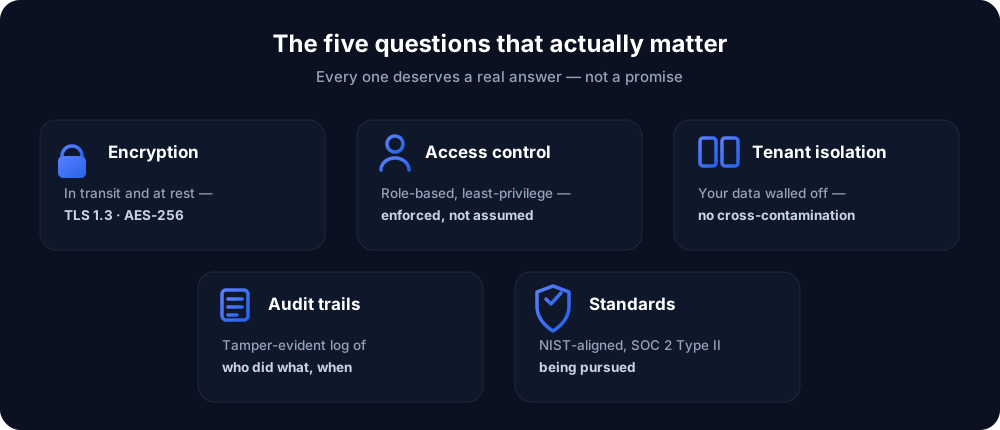
When contractors raise security concerns about a cloud pricing tool, the worry usually isn't abstract. It clusters around a handful of specific, legitimate fears. Each one deserves a real answer.
Is my data encrypted — everywhere?
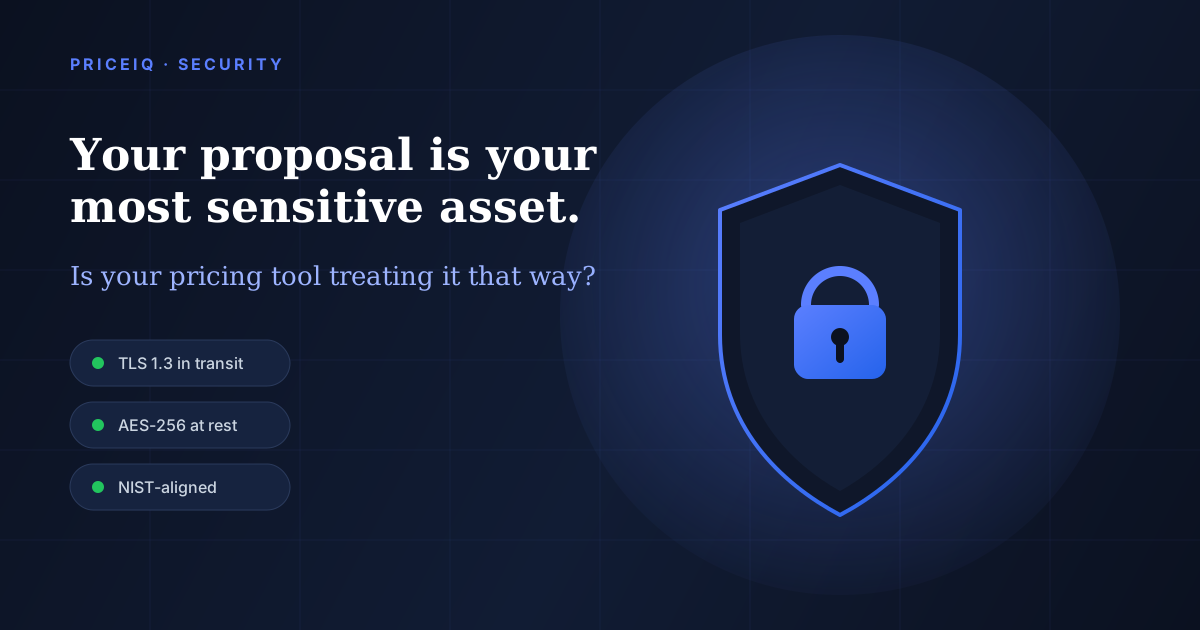
Encryption is the baseline, but the detail matters. Data needs protection in two states: in transit, as it moves between your browser and the platform, and at rest, as it sits stored on the platform's servers. A tool that encrypts one but not the other has left a door open. The modern standard is TLS 1.3 for data in transit and AES-256 for data at rest — the same caliber of encryption used to protect financial and government systems. If a vendor can't tell you both, that's your answer.
Who can see my data inside the platform?
Encryption protects against outsiders. Access controls protect against the more common risk: the wrong person inside seeing something they shouldn't. This is where role-based access control (RBAC) comes in. Not everyone on a proposal team needs to see everything — your pricing strategy may be need-to-know even internally. Granular roles that separate administrators from standard users, and limit each person to the data their job requires, are what turn “we trust our team” into “our system enforces it.”
What if I share infrastructure with other companies?
This is the fear unique to cloud and multi-tenant platforms, and it's a reasonable one: if another contractor uses the same tool, could our data ever bleed into theirs? The answer that should reassure you is multi-tenant isolation — an architecture where each organization's data is walled off completely, with no possibility of cross-contamination or unauthorized cross-access. One tenant's pricing volume should be invisible and inaccessible to every other tenant, by design, at the infrastructure level.
Can I prove what happened, and when?
Federal work runs on accountability. When a contracting officer, an auditor, or your own compliance team asks who accessed a document and what they did with it, “we think so” is not an acceptable answer. Comprehensive audit trails — a complete, tamper-evident log of every action taken in the system — turn that question into a report you can pull on demand. They're not just a security feature; they're a compliance instrument.
Does this align with the standards I'm already held to?
Government contractors live under frameworks like the NIST Cybersecurity Framework, and increasingly under CMMC requirements for handling sensitive defense information. A pricing tool that aligns its controls with NIST standards isn't just checking a box — it's making sure that adopting the tool doesn't introduce a gap in the compliance posture you've worked to build. Your vendors are part of your security perimeter now. They need to meet the bar you're held to.
Security is a chain, and your vendor is a link
Here's the strategic reframe that mature contractors have internalized: your security is only as strong as your weakest vendor. You can run a tight ship internally — trained staff, locked-down systems, careful CUI handling — and still expose yourself by routing sensitive proposal data through a tool that doesn't take security as seriously as you do.
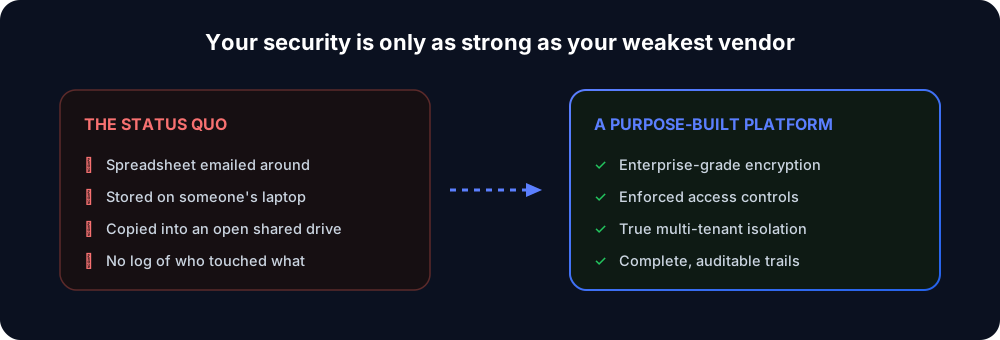
This is why evaluating a pricing platform's security isn't a box-checking exercise to delegate to IT at the end. It's a core part of the buying decision, because the platform becomes an extension of your own attack surface. The right tool strengthens your posture by giving sensitive data a more controlled, more auditable, more isolated home than the spreadsheet-and-email status quo it replaces. The wrong tool quietly weakens it.
The good news: choosing well can actually be an upgrade. Moving pricing data off scattered laptops and ad-hoc shared drives into a purpose-built platform with enterprise-grade encryption, enforced access controls, and complete audit trails is, for many teams, a meaningful improvement over how they handle that data today.
How PriceIQ approaches security
PriceIQ was built on the premise that proposal data is critical and should be treated that way — with security designed into every layer of the platform, not bolted on afterward. Here's how that maps to the questions above.
- Encryption, end to end. All data is encrypted in transit using TLS 1.3 and at rest using AES-256 — the enterprise-grade standard for protecting sensitive information in both states.
- Role-based access control. Granular permissions with distinct administrator and user roles ensure team members access only the data they need — making need-to-know an enforced rule, not a hopeful policy.
- Multi-tenant isolation. Each organization's data is completely isolated, preventing any cross-contamination or unauthorized access between tenants. Your pricing volumes are yours alone.
- Complete audit trails. Every action is logged, providing the transparency and accountability that federal compliance requirements demand — and the ability to answer “who did what, when” with a report rather than a guess.
- NIST-aligned standards. PriceIQ's security practices align with NIST guidelines to support the requirements government contractors operate under, with SOC 2 Type II certification actively being pursued for additional assurance.
- Secure infrastructure and defense in depth. The platform runs on industry-leading cloud infrastructure with 99.9% uptime, backed by bcrypt password hashing, short-lived session tokens, protection against common web attacks like SQL injection and cross-site scripting, rate limiting and DDoS protection, automated backups, and disaster recovery. Security monitoring runs around the clock, with an incident response target measured in under an hour.
The bottom line
Adopting an AI pricing tool shouldn't mean trading away control of your most sensitive data — it should mean giving that data a safer home than it has today. The right platform meets you at the security bar you're already held to as a federal contractor, and then clears it.
Ask the hard questions of any tool you're evaluating. Encryption in transit and at rest. Enforced access controls. True tenant isolation. Complete audit trails. Alignment with the standards you live under. A vendor confident in its security will have clear answers — and PriceIQ was built to.